Automation, Missile Swarms, and the Strategic Limits of the Islamic Republic's War Machine
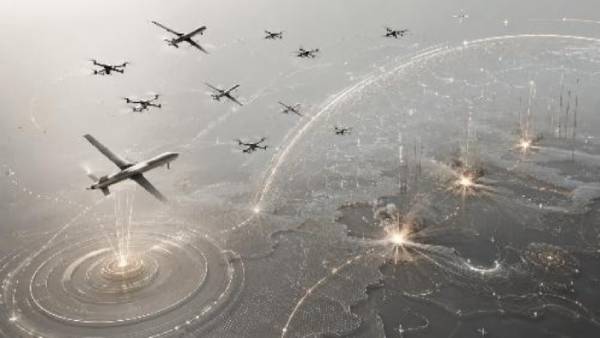
The current Israel–U.S.–Iran war has brought a familiar yet increasingly urgent question into focus: what happens when military technology becomes cheap, scalable, and automated enough to allow a state to sustain repeated attacks without necessarily possessing the conventional military capacity to win a prolonged war? The Islamic Republic of Iran offers a revealing case. Its growing reliance on drones, ballistic missiles, cruise missiles, and coordinated swarm tactics demonstrates how automation and relatively inexpensive weapons systems can expand a state's capacity to project force. Yet the war also exposes the limits of this model. The ability to launch large numbers of weapons is not the same as the ability to achieve strategic objectives, and the low cost of individual drones or missiles can conceal the enormous economic, infrastructural, and political costs of the war they help sustain.
The Islamic Republic's approach to warfare has relied increasingly on combining quantity, technological accessibility, and layered attacks. Drones can be produced and deployed at a relatively low cost compared with sophisticated conventional weapons systems. Missiles offer greater range and destructive potential, while the simultaneous use of different weapons creates operational complexity for an adversary's defenses. Swarm attacks are designed to overwhelm or saturate defensive systems by launching multiple threats from different directions at once. The logic is straightforward: if individual weapons are relatively inexpensive, a state may be able to launch them in large numbers and force an adversary to expend considerably more resources to intercept them. This approach has given the Islamic Republic an important asymmetric capability. It does not need to match Israel or the United States aircraft for aircraft, or possess equivalent conventional military power, to threaten civilian populations and strategic infrastructure. Automation and mass production have allowed Tehran to compensate, at least partially, for some of its conventional military limitations. The drone and missile arsenal provides reach, deterrence, and the ability to impose costs on a technologically superior adversary.
But the strategic value of these systems cannot be measured simply by the number of weapons launched.
The Islamic Republic's experience highlights the distinction between tactical disruption and strategic effectiveness. A large-scale missile or drone attack may temporarily disrupt infrastructure, force defensive mobilization, or create psychological pressure. Yet if most incoming weapons are intercepted, fail to reach their intended targets, or cause limited strategic damage, the operational success of launching large numbers of weapons may not translate into a meaningful strategic victory. The low cost of production can enable repeated attacks, but repetition alone does not guarantee effectiveness. This is where the economics of automated warfare become particularly important. The relative affordability of drones can create the illusion of an almost limitless offensive capacity. But the cost of war extends far beyond the price of the weapons themselves. Every attack risks retaliation. Every escalation places additional pressure on national infrastructure, energy systems, industrial capacity, and the broader economy. A state may be able to produce inexpensive drones, but it cannot necessarily absorb the economic consequences of a prolonged war. The Islamic Republic's current position illustrates this contradiction. While its drones and missiles may be relatively inexpensive to manufacture compared with the sophisticated defense systems designed to intercept them, the broader costs of sustained conflict are far greater. Iran's infrastructure has come under attack, its energy and oil-export capacity has been severely disrupted, and its already fragile economy faces further pressure. The economic consequences of war can therefore outweigh the apparent financial advantage of low-cost offensive weapons.
This creates a fundamental paradox at the heart of automated warfare: the weapon may be cheap, but the war is not.
Automation also alters escalation logic. When a state can produce large numbers of relatively inexpensive drones and missiles, the threshold for launching an attack may drop. The availability of mass-produced weapons creates an incentive to rely on quantity, repetition, and saturation rather than precision and restraint. Swarm attacks can complicate defensive operations and force an adversary to expend expensive interceptors against cheaper incoming weapons. Yet this asymmetry is not necessarily sustainable. The attacker may save money on individual weapons while exposing itself to the far greater costs of retaliation and prolonged conflict. The Islamic Republic's experience therefore challenges the assumption that cheap, automated weapons necessarily confer a durable strategic advantage. Automation can democratize access to military capabilities, allowing states with limited conventional power to threaten much stronger adversaries. But technological accessibility does not eliminate the fundamental requirements of war: economic resilience, industrial capacity, infrastructure, logistics, political stability, and the ability to sustain military operations over time.
In this sense, the Islamic Republic's use of drones and missiles reveals a broader transformation in modern warfare. The battlefield is increasingly shaped by the interplay between inexpensive offensive systems and highly sophisticated defensive technologies. One side can launch large numbers of relatively cheap weapons; the other can deploy expensive systems to detect, track, and intercept them. This creates an asymmetric economic contest in which the immediate cost of an attack and the long-term cost of war can diverge dramatically. The question, then, is not simply whether automated systems make warfare cheaper. They make some forms of warfare cheaper to initiate and sustain at the tactical level. They do not, however, make war strategically affordable.
The Islamic Republic's experience also shows that technological adaptation cannot replace political strategy. Drones and missiles may extend a state's reach, but they cannot, by themselves, protect infrastructure, sustain an economy, preserve energy exports, or guarantee political survival. Nor can they indefinitely compensate for the consequences of strategic miscalculation. A state may succeed in launching a swarm attack while losing ground in the broader strategic environment. There is therefore a deeper lesson in the Islamic Republic's reliance on automated and mass-produced weapons. The future of warfare may increasingly belong to systems that are cheap enough to produce in large numbers, easy enough to transport and deploy, and sophisticated enough to complicate an adversary's defenses. But the ability to create a swarm is not the same as the ability to win a war. The Islamic Republic's experience suggests that the strategic effectiveness of automation must ultimately be measured not by the number of drones or missiles a state can launch, but by what those weapons actually achieve, and by what the state must sacrifice to keep launching them.
Missile and drone swarms can create tactical pressure, impose costs, and challenge even advanced defensive systems. But when the broader consequences include damaged infrastructure, disrupted energy exports, economic collapse, and escalating retaliation, the apparent efficiency of automated warfare begins to reveal its limits. The weapons may be cheap. The consequences are not. The central question is therefore no longer whether automation will transform warfare. It already has. The more important question is whether states will mistake the ability to launch inexpensive, technologically sophisticated attacks for the ability to achieve sustainable strategic outcomes. The Islamic Republic's experience offers a cautionary case: automation can make war easier to wage, but it cannot make war inexpensive, sustainable, or strategically successful.
photo generated by ChatGPT
Jul 29, 2026 by
- share:


